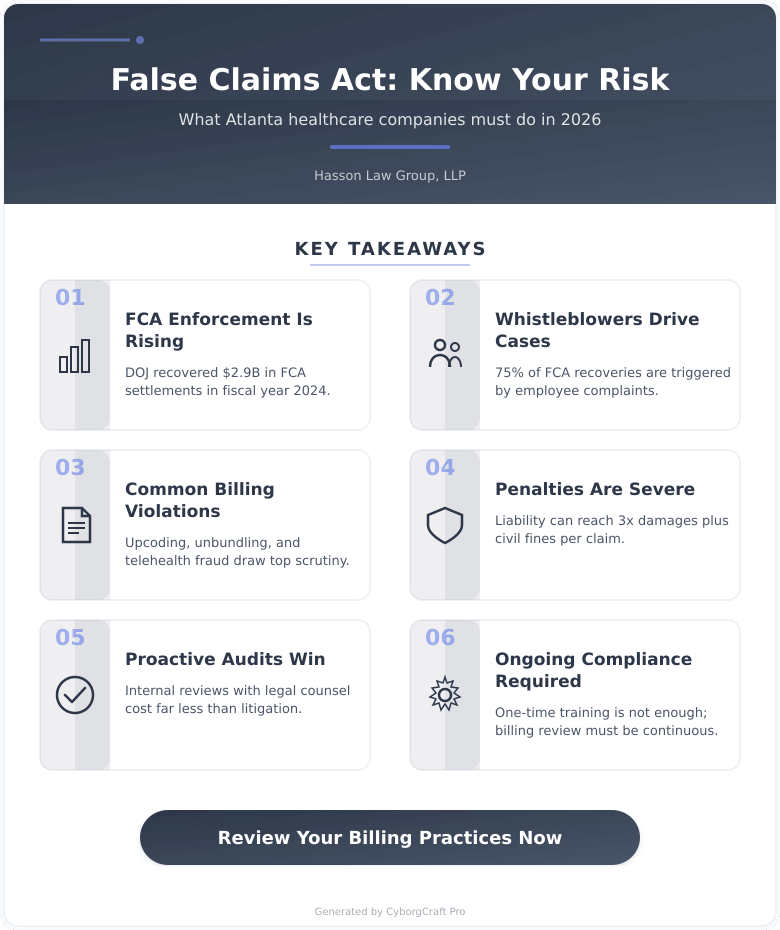
False Claims Act Enforcement in 2026: Why Atlanta Healthcare Companies Should Be Reviewing Their Billing Practices Right Now

False Claims Act enforcement is intensifying heading into 2026, and Atlanta-area healthcare organizations that bill Medicare or Medicaid face real exposure if billing compliance has not been a recent priority. Federal DOJ recoveries exceeded $2.9 billion in fiscal year 2024, with healthcare accounting for the largest share. Most cases begin not with a federal audit, but with a whistleblower - often a current or former employee - filing a qui tam complaint that stays sealed while investigators build a case. High-risk billing patterns in 2026 include telehealth documentation gaps, upcoding of evaluation and management services, and unbundling of laboratory codes. The post outlines why proactive internal audits conducted with legal oversight consistently produce better outcomes than reactive defense after a complaint surfaces. Georgia organizations also face exposure under the state's own False Medicaid Claims Act, which parallels federal standards. A five-step compliance action plan covers baseline auditing, telehealth documentation review, whistleblower risk assessment, voluntary disclosure evaluation, and updated staff training. A document checklist, comparison of compliance approaches with cost ranges, and a detailed FAQ section address common questions about penalties, investigation timelines, and the OIG Self-Disclosure Protocol. The core message is clear: organizations that get ahead of billing irregularities now have far more control over the outcome than those who wait.
Continue ReadingFalse Claims Act Enforcement in 2026: Why Atlanta Healthcare Companies Should Be Reviewing Their Billing Practices Right Now

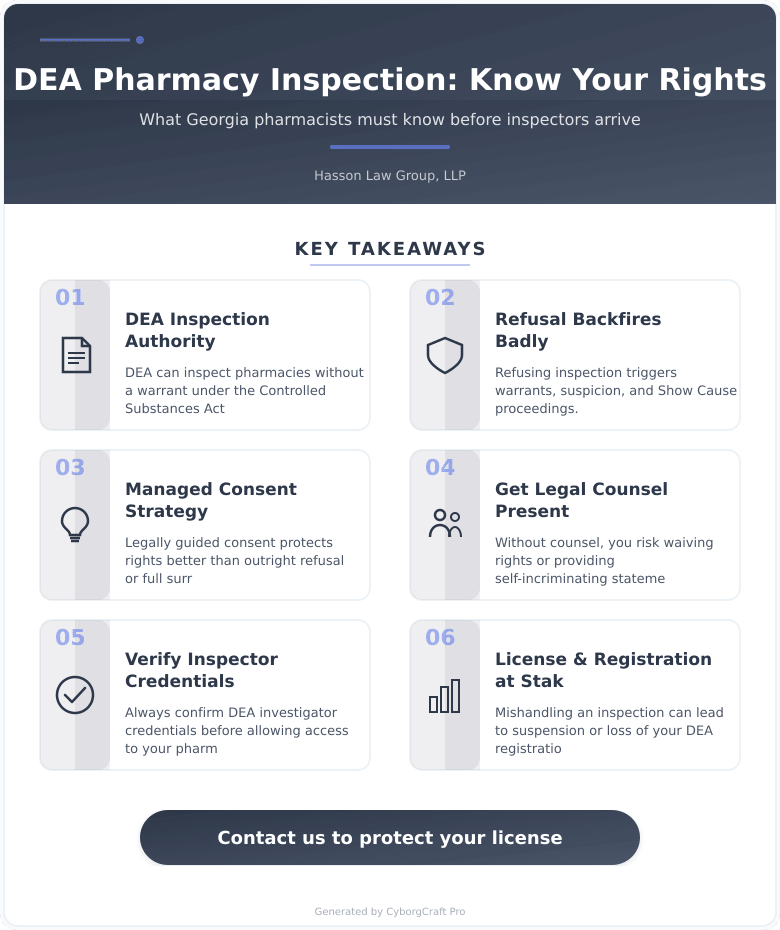
What Happens If You Refuse a DEA Pharmacy Inspection in Georgia? The Answer Could Save Your License

Refusing a DEA pharmacy inspection in Georgia is one of the highest-risk decisions a pharmacy owner can make. Under the Controlled Substances Act, DEA Diversion Investigators have broad administrative authority to inspect records, inventory, and security systems without a warrant when a registrant consents - and outright refusal can trigger immediate escalation, inspection warrants, and Order to Show Cause proceedings against your DEA registration. Georgia pharmacies face a dual compliance structure: DEA findings can independently trigger action by the Georgia State Board of Pharmacy under state law. In 2026, the DEA Atlanta Division has increased its inspection frequency, with particular focus on pharmacies flagged through Georgia's PDMP for high-volume Schedule II dispensing. The post outlines the difference between administrative inspections and criminal investigations, explains when managed consent with legal counsel is the right approach versus outright refusal, and provides a six-step action plan pharmacists can follow when investigators arrive. It also covers the most common mistakes Georgia pharmacy owners make during inspections, including allowing multiple staff members to answer questions and failing to document what records were copied. A comparison table breaks down the legal risk and escalation potential of each possible response strategy. The FAQ section addresses warrant requirements, license jeopardy timelines, and whether involving an attorney during an inspection raises suspicion. The core message: your DEA registration is the foundation of your business, and the time to prepare is before an investigator walks through your door.

Continue ReadingWhat Happens If You Refuse a DEA Pharmacy Inspection in Georgia? The Answer Could Save Your License

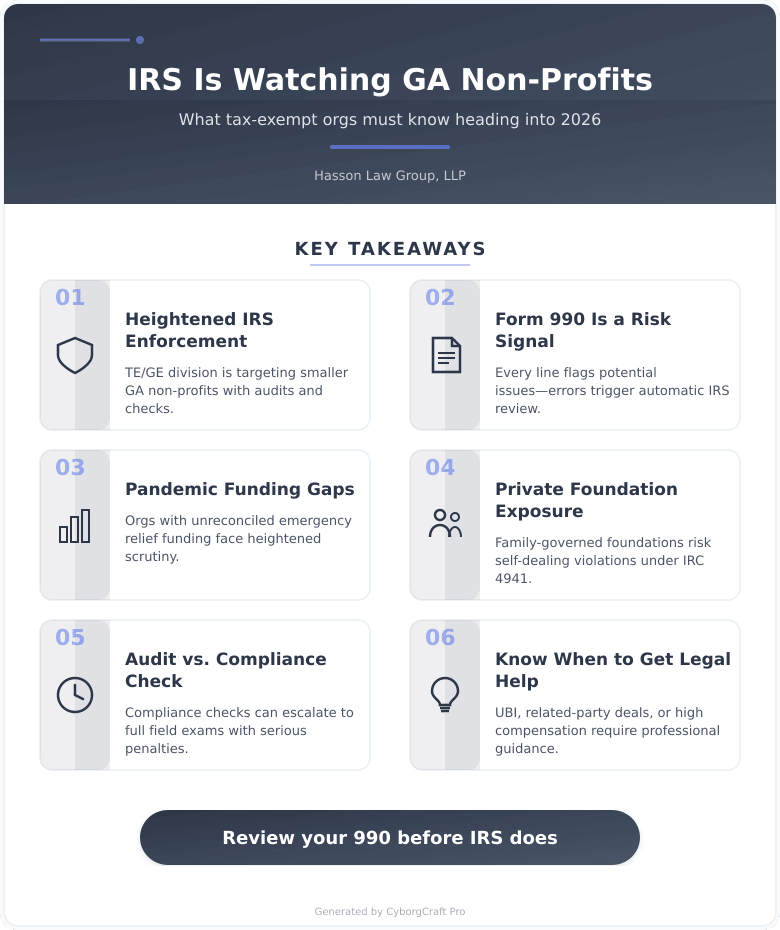
Georgia Non-Profits and Foundations: The IRS Scrutiny You Didn’t See Coming in 2026

Georgia non-profits and private foundations are facing a sharp increase in IRS scrutiny heading into 2026, driven by expanded TE/GE compliance initiatives and unresolved pandemic-era financial discrepancies. The post explains what triggers IRS attention - including Form 990 errors, executive compensation issues, unreported unrelated business income, and self-dealing risks for private foundations. It breaks down the difference between compliance checks, correspondence audits, and full field examinations, with a comparison table showing timelines and potential outcomes for each review type. Georgia-specific factors are covered in detail, including the dual compliance burden of federal IRS requirements and state charitable solicitation registration with the Georgia Secretary of State. A five-step compliance action plan and a preparation checklist give organizations concrete steps to take before IRS contact arrives. The post also compares self-managed compliance against professional legal guidance, helping organizations understand when professional involvement is essential. A neighboring-state comparison highlights where Georgia's requirements differ from Florida, Tennessee, and South Carolina. Seven FAQ answers address common questions about audit triggers, 501(c)(3) revocation, UBI state taxation, and how to respond when an IRS letter arrives. The content is tailored for Georgia non-profit leaders, board members, and foundation trustees who need to understand their 2026-2026 compliance exposure and take action before problems escalate.

Continue ReadingGeorgia Non-Profits and Foundations: The IRS Scrutiny You Didn’t See Coming in 2026

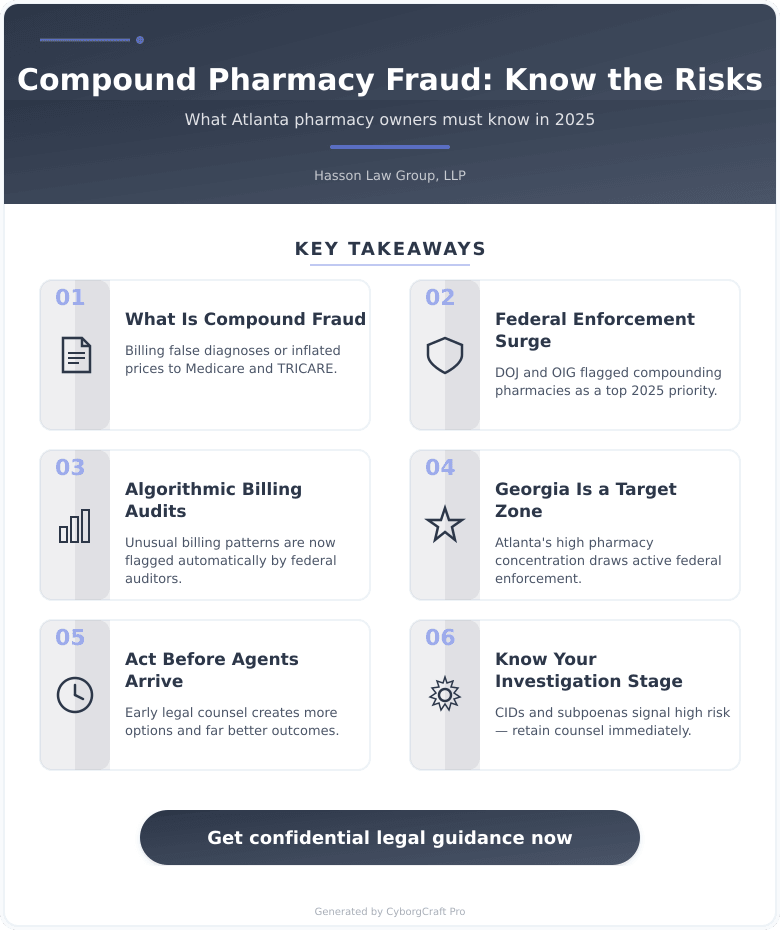
Compound Pharmacy Fraud Investigations Are Surging – What Atlanta-Area Owners Need to Know Before Agents Knock

Compound pharmacy fraud investigations have become one of the federal government's top healthcare enforcement priorities in 2026, and Atlanta-area pharmacy owners are facing real exposure. Federal agencies including the DOJ and OIG are using automated billing analysis to flag compounding pharmacies that show unusual Medicare or TRICARE billing patterns - and Georgia's dense healthcare market makes it a recurring target. The post walks pharmacy owners through what actually triggers an investigation, the difference between a routine audit and a Civil Investigative Demand, and why the stage at which you engage legal counsel dramatically affects your options. A clear comparison of proactive versus reactive approaches shows that waiting is almost always the more costly path. The post includes a five-step action plan pharmacy owners can follow immediately, a document preparation checklist, and definitions of key legal terms like the False Claims Act and Civil Investigative Demand. A comparison table maps out investigation stages, timelines, risk levels, and recommended actions. Six FAQ answers cover statute of limitations questions, warrantless inspection rights, typical investigation timelines, and potential penalties in federal court. The post is anchored to Hasson Law Group, LLP in Atlanta and includes clear guidance on when and how to seek legal counsel before federal contact escalates.

Continue ReadingCompound Pharmacy Fraud Investigations Are Surging – What Atlanta-Area Owners Need to Know Before Agents Knock