

Medicare fraud prosecution in Georgia is entering a new phase in 2026, shaped by coordinated federal anti-fraud enforcement postures from both CMS and the Department of Justice. This shift places Georgia healthcare providers under sharper federal scrutiny and raises the stakes for billing compliance across the state.

This guide focuses specifically on how these evolving enforcement approaches affect Georgia-based healthcare providers facing Medicare fraud allegations or compliance risk in 2026.
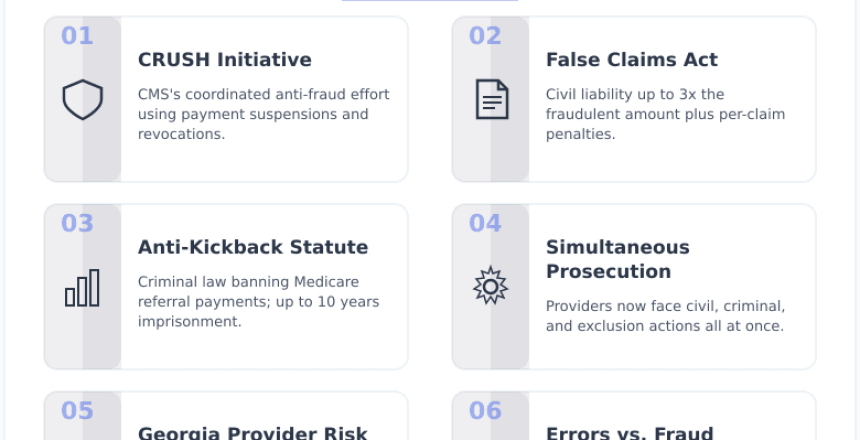
CRUSH Initiative Definition: CMS’s CRUSH initiatives aim to combat Medicare fraud through tools like payment suspensions and revocations, while DOJ pursues related criminal cases separately.
If you run a medical practice, own a home health agency, operate a pharmacy, or provide any Medicare-reimbursed service in Georgia, this is not background noise. The pattern of federal enforcement has changed. Federal prosecutors and HHS-OIG investigators are coordinating closely on healthcare fraud matters, and both agencies bring well-developed tools and strategies to bear against providers.
What These Anti-Fraud Enforcement Efforts Actually Do to Medicare Fraud Cases
CRUSH refers to CMS’s “Crushing Fraud” anti-fraud efforts, without the specified acronym. It isn’t a single statute. It reflects a broader enforcement posture that bundles tools previously used separately.
False Claims Act (FCA): The federal law imposing civil liability of up to three times the fraudulent amount plus per-claim penalties, which are adjusted periodically and can reach substantial amounts per false claim.
Anti-Kickback Statute (AKS): A criminal law prohibiting payments to induce Medicare referrals, with each violation carrying up to 10 years imprisonment.
Under coordinated federal enforcement, prosecutors pursue FCA civil liability, AKS criminal charges, and Medicare exclusion simultaneously – rather than sequentially. That means a provider can face financial ruin, a federal indictment, and loss of Medicare enrollment at the same time. Federal enforcement activity targeting healthcare fraud has increased notably in recent years across the southeastern United States, including Georgia. The DOJ’s Health Care Fraud Unit coordinates these multi-track actions nationally, including in Georgia.
Want to explore this further? Contact us to discuss your specific situation before issues escalate.
Why Georgia Healthcare Providers Are Particularly Exposed
Georgia sees significant Medicare billing volume, which attracts federal attention. The Atlanta metro area, home to major hospital systems and thousands of independent providers, has historically been a focus of HHS-OIG audits.
Several factors make coordinated federal enforcement especially relevant in Georgia right now:
- Georgia Medicaid and Medicare overlap is significant – dual-eligible patients create billing complexity that triggers audit flags
- Home health and behavioral health providers in Georgia have seen increased pre-payment review activity in 2026
- Telemedicine billing, expanded during the pandemic, is now subject to increased federal scrutiny nationally
- Physician-owned distributorships and DME arrangements draw AKS review
The most common mistake providers make is assuming that billing errors and fraud allegations are the same thing. They’re not – but federal prosecutors can reframe patterns of errors as evidence of intent. That reframing is where providers lose control of their situation.
Coordinated Prosecution vs. Traditional Medicare Fraud Enforcement: Which Approach Is More Dangerous?
Where traditional enforcement succeeds: Gives providers time to respond to civil investigative demands, negotiate settlements, and correct billing practices before criminal exposure solidifies.
Where traditional enforcement fails: Allows sophisticated fraud schemes to continue during slow sequential proceedings; limits deterrence effect on high-volume false billing.
Where the coordinated approach succeeds: Maximizes pressure on targets, accelerates resolution, and creates stronger deterrence signals across the provider community in Georgia.
Where the coordinated approach fails: Increases risk of overreach against providers with billing errors rather than intentional fraud; compresses the window for voluntary compliance correction.
The verdict: For Georgia providers, coordinated prosecution is objectively more dangerous because it eliminates the sequential buffer that once allowed compliance corrections before criminal exposure. Providers with even moderate billing irregularities now face compounded legal risk if they don’t address compliance proactively.
| Enforcement Type | Timeline | Exposure Level | Provider Impact |
|---|---|---|---|
| Traditional Civil FCA | 12-36 months | Financial penalties | Settlements, repayment |
| Criminal AKS alone | 6-18 months indictment | Criminal conviction risk | Incarceration, fines |
| Coordinated Multi-Track | Simultaneous tracks | Maximum exposure | Criminal + civil + exclusion |
| Administrative Exclusion | 30-90 days notice | Practice-ending | Loss of Medicare enrollment |
Thinking about this for your situation? Let’s talk. We’ll walk you through your options – no pressure. Reach out to Hasson Law Group, LLP directly.
Your Medicare Compliance Action Plan for 2026
- Step 1 – Internal Billing Audit: Pull 90 days of Medicare claims and compare against documentation. Flag any claims where supporting records are incomplete or missing. This is your baseline risk picture.
- Step 2 – AKS Arrangement Review: Identify every referral relationship, space rental, staffing arrangement, or vendor contract that involves a Medicare referral source. Have each reviewed against current safe harbor regulations.
- Step 3 – Voluntary Disclosure Assessment: If the audit reveals patterns of overpayment, evaluate the CMS Self-Referral Disclosure Protocol or the OIG’s voluntary disclosure program before a federal investigation begins. Disclosure before detection typically results in significantly reduced penalties.
- Step 4 – Response Protocol Preparation: Establish a clear internal protocol for what happens if your practice receives a subpoena, civil investigative demand, or OIG inquiry. Staff should know not to speak with investigators without legal counsel present.
- Step 5 – Legal Counsel Engagement: If you identify material risk, engage qualified healthcare legal counsel immediately. The window between investigation initiation and formal charge filing is where outcomes are shaped.
What to Gather Before Any Legal Consultation
- ☐ Last 12 months of Medicare remittance advices
- ☐ Any OIG, RAC, or MAC audit correspondence received
- ☐ Employment and independent contractor agreements with referral sources
- ☐ Space and equipment lease agreements with physicians or hospitals
- ☐ Telemedicine service agreements and platform documentation
- ☐ Internal compliance policies and training records
- ☐ Any prior repayment agreements with CMS or contractors
Key Takeaways for Georgia Healthcare Providers in 2026
- Coordinated enforcement changes the timeline – simultaneous multi-track enforcement removes the sequential buffer providers once relied on to correct course
- Billing errors can become fraud allegations – patterns matter more than individual mistakes under this framework
- Georgia is a priority enforcement state – high Medicare volume means heightened federal attention through 2026
- Voluntary disclosure still offers advantages – acting before an investigation starts typically reduces exposure significantly
- Legal counsel engagement should be early – the investigation phase, not the charging phase, is when outcomes are determined
Frequently Asked Questions
What are the current federal Medicare fraud enforcement priorities?
Federal enforcement combines CMS anti-fraud tools such as payment suspensions and revocations with DOJ criminal prosecution, creating coordinated pressure that simultaneously pursues criminal charges, civil penalties, and administrative exclusion against healthcare providers accused of Medicare fraud. Unlike traditional sequential enforcement, this coordinated approach compresses all legal tracks into one action, dramatically increasing pressure and exposure for targeted providers.
Can billing mistakes lead to criminal charges under coordinated enforcement?
Repeated billing errors can be reframed as evidence of intentional fraud if prosecutors identify a pattern, especially under coordinated enforcement. Individual mistakes rarely trigger criminal action, but systematic overbilling or documentation gaps across hundreds of claims creates genuine criminal exposure.
How does Medicare fraud prosecution differ in Georgia compared to neighboring states?
Georgia’s high Medicare billing volume and the concentration of providers in Atlanta make it a priority enforcement state compared to Alabama or South Carolina. Georgia federal districts have seen active healthcare fraud enforcement activity in 2026, reflecting broader coordinated enforcement efforts across southeastern enforcement regions.
What should a Georgia provider do immediately after receiving an OIG subpoena?
Stop all internal discussion about the subject matter of the subpoena and contact healthcare legal counsel before responding to any investigator. Statements made to federal investigators without counsel present can be used against you even if no charges have been filed.
Does voluntary disclosure actually reduce penalties for Medicare fraud?
Yes – providers who self-disclose through CMS or OIG programs before an investigation begins typically resolve matters at lower penalty multiples than those who are investigated first. The OIG’s voluntary disclosure protocol has historically resulted in settlements at one-and-a-half times the overpayment rather than the standard three-times multiplier under the False Claims Act.
How long do Medicare fraud investigations typically take in Georgia?
Federal healthcare fraud investigations in Georgia typically run 12 to 36 months from initial audit to resolution, though coordinated multi-track actions can compress civil and criminal timelines significantly. Providers often don’t know they’re under investigation until a subpoena or search warrant arrives, making proactive compliance the only reliable protection.
What This Means for Your Practice Right Now
Coordinated federal enforcement isn’t hypothetical. Federal prosecutors in Georgia are actively using multi-track enforcement tools, and the latest data from the DOJ’s health care fraud strike force shows southeastern enforcement actions are up sharply heading into 2026.
At Hasson Law Group, LLP, we work with healthcare providers across Atlanta and throughout Georgia who are navigating exactly these concerns. Whether you’ve received a formal inquiry or simply want to understand your exposure before something happens, getting the right guidance early makes a real difference.
Ready to take the next step? Contact us today for straight answers and a clear picture of where your practice stands – because the time to act is before a federal investigation begins, not after.
This content is provided for informational purposes only and does not constitute legal advice. Healthcare providers facing federal investigation or compliance concerns should consult qualified legal counsel promptly.