
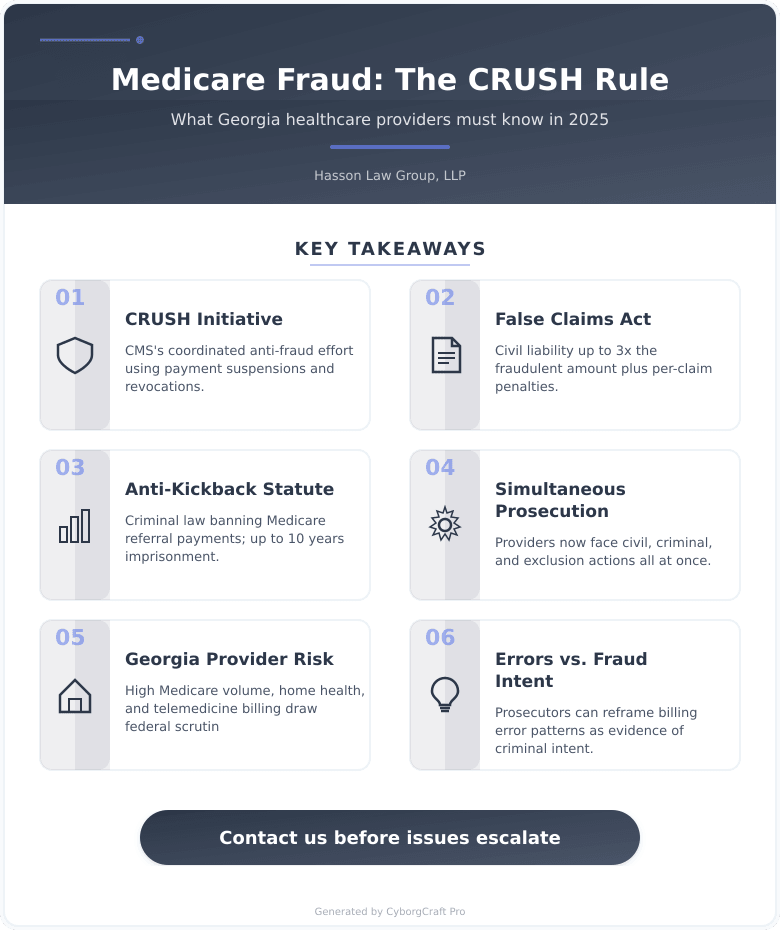
The DOJ’s New “CRUSH Rule” Could Change How Medicare Fraud Is Prosecuted in Georgia – Here’s What It Means for Healthcare Providers
The DOJ's CRUSH Rule represents a significant shift in how Medicare fraud is prosecuted across the country, and Georgia healthcare providers are directly in the crosshairs. The framework - standing for Coordinated, Rapid, Unified, Systematic, and High-impact enforcement - allows federal prosecutors to pursue criminal charges, civil False Claims Act penalties, and Medicare exclusion simultaneously rather than sequentially. This removes the buffer that once allowed providers to correct billing issues before criminal exposure materialized. Georgia's high Medicare billing volume makes it a priority enforcement state, with federal districts in the Northern and Middle Districts actively coordinating with HHS-OIG investigators. Key risks include telemedicine billing under retroactive scrutiny, home health and behavioral health pre-payment reviews, and Anti-Kickback Statute exposure from physician referral arrangements. The post walks providers through a five-step compliance action plan, a document preparation checklist for legal consultations, and a comparison of CRUSH enforcement versus traditional Medicare fraud prosecution timelines. Voluntary self-disclosure through OIG or CMS programs before an investigation begins remains one of the most effective ways to reduce penalty exposure. Healthcare providers who identify material billing risk in 2026 are strongly encouraged to engage legal counsel early, as the investigation phase rather than the charging phase is where outcomes are most effectively shaped.