

A DEA pharmacy inspection in Georgia is a formal administrative review of a DEA-registered pharmacy’s controlled substance records, storage, and compliance practices. Refusing or mishandling one can trigger license suspension, Show Cause proceedings, or federal prosecution.
This guide focuses specifically on Georgia-licensed pharmacists and pharmacy owners facing DEA administrative inspections under 21 U.S.C. 880 and related federal regulations.
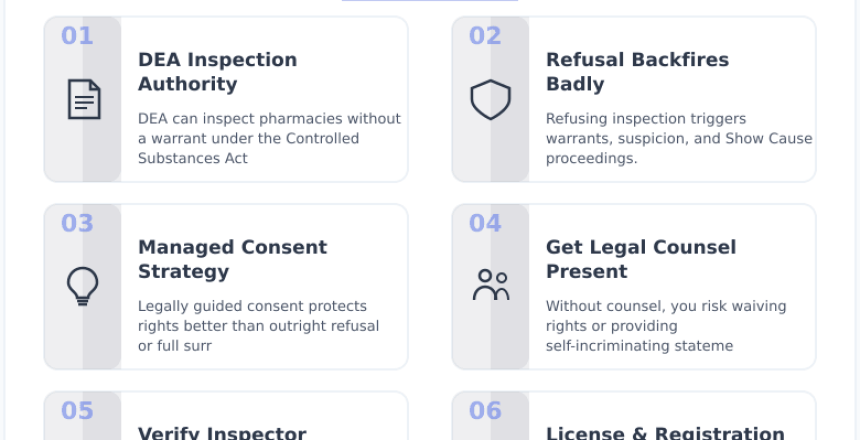
DEA Pharmacy Inspection Definition: A DEA administrative inspection is a warrantless regulatory visit authorized under the Controlled Substances Act, allowing DEA Diversion Investigators to review records, inventory, and premises of registered pharmacies without prior notice.
Here’s the thing most pharmacists don’t realize until it’s too late: refusing a DEA inspection is not a clean legal strategy. It almost always accelerates the very outcome you’re trying to avoid. The most common mistake professionals make is conflating their Fourth Amendment rights with the specific administrative inspection authority Congress granted the DEA. Those are two different legal universes.
What the DEA Can Actually Do During a Georgia Pharmacy Inspection
Under the Controlled Substances Act (CSA), DEA Diversion Investigators have broad authority during administrative inspections. This includes reviewing all Schedule II-V controlled substance records going back two years, inspecting physical storage and security, and auditing dispensing logs. Georgia pharmacies also answer to the Georgia State Board of Pharmacy, which can conduct concurrent or follow-up inspections independently.
Inspection authority includes:
- Access to all controlled substance inventories and dispensing records
- Review of biennial inventory documentation
- Inspection of physical vault and security systems
- Copies of prescriptions for controlled substances
- Employee credentialing and DEA registration records
DEA diversion enforcement activity has remained a consistent regulatory priority for retail pharmacies, with particular focus on states experiencing high opioid prescription volumes – including Georgia. The DEA Diversion Control Division oversees these administrative inspection programs nationally.
DEA Inspection Consent vs. Refusal: Which Approach Works?
Where consenting to inspection succeeds: Preserves your DEA registration, demonstrates good faith, limits escalation risk, and keeps the interaction administrative rather than criminal.
Where consenting to inspection fails: Without legal counsel present or available by phone, you may inadvertently waive rights, provide statements used against you, or allow broader access than legally required.
Where refusing inspection succeeds: In narrow circumstances involving criminal investigations (not administrative ones), invoking your right to an administrative inspection warrant may be procedurally appropriate.
Where refusing inspection fails: For standard administrative inspections, refusal gives the DEA legal grounds to seek an inspection warrant, triggers automatic suspicion of non-compliance, and can accelerate an Order to Show Cause on your registration.
The verdict: Outright refusal during a routine administrative inspection almost never works in your favor. The smarter path is a managed, legally guided consent – not a blanket refusal and not a blanket surrender.
| Response Option | Legal Risk | DEA Escalation | Best For |
|---|---|---|---|
| Full Cooperation | Low to moderate | Minimal | Pharmacies with clean records |
| Managed Consent with Counsel | Low (with guidance) | Low | Pharmacies with potential exposure |
| Partial Refusal (scope dispute) | Moderate | Moderate | Legally defensible scope challenges only |
| Full Refusal | Very high | Immediate escalation | Almost never appropriate for admin inspection |
Thinking about this for your situation? Let’s talk. Contact us and we’ll walk you through your options – no pressure.
Your DEA Pharmacy Inspection Action Plan
- Step 1 – Verify credentials immediately: Ask for the investigator’s DEA credentials and note their name and badge number. This is your right and sets a professional tone.
- Step 2 – Call legal counsel before answering substantive questions: You can say, “I want to cooperate fully – I’d like to reach my attorney by phone first.” This is not refusal.
- Step 3 – Identify the inspection type: Ask whether this is an administrative inspection under 21 U.S.C. 880 or a criminal investigation. Your rights differ significantly.
- Step 4 – Designate one spokesperson: Only one pharmacy representative should speak. Conflicting statements from multiple staff members create unnecessary exposure.
- Step 5 – Document everything contemporaneously: Write down what was reviewed, what was copied, and what was said during the inspection.
- Step 6 – Follow up with a legal review: Even if the inspection concludes without incident, have counsel review findings before responding to any post-inspection correspondence.
Georgia-Specific Risks That Make This More Urgent in 2026
Georgia pharmacies face a dual-layer compliance environment. The DEA handles federal registration, but the Georgia State Board of Pharmacy (GSBP) holds independent authority over state licensure. A DEA finding does not have to result in federal prosecution to cost you your state license – the GSBP can act on DEA inspection findings independently under O.C.G.A. Title 26.
Georgia pharmacies operating in 2026 should be aware that DEA diversion enforcement continues to focus on dispensing pattern compliance, and pharmacies with elevated controlled substance activity may be subject to closer regulatory scrutiny.
Georgia PDMP compliance note (2026): Georgia mandates PDMP checks before dispensing Schedule II-IV controlled substances. Inspection investigators will cross-reference your PDMP query logs against your dispensing records. Gaps are immediate red flags.
Common Mistakes Georgia Pharmacists Make During Inspections
- Allowing staff to answer questions without a designated spokesperson
- Assuming the inspection is routine when it may be investigative
- Providing voluntary access beyond what the administrative authority requires
- Failing to document what records were copied or reviewed
- Not contacting legal counsel until after the inspection concludes
The pattern we see most often is a pharmacy owner who cooperated fully and in good faith – but without understanding the scope of what they agreed to. Good intentions don’t override the evidentiary record created during an inspection.
Key Takeaways for Georgia Pharmacy Owners in 2026
- Refusal has consequences – outright refusal to an administrative inspection can trigger immediate DEA escalation and jeopardize your registration
- Managed cooperation is the goal – consenting strategically with counsel guidance is not the same as blanket surrender
- Georgia’s dual-authority structure matters – DEA findings can trigger GSBP action independently under Georgia law
- PDMP compliance is scrutinized – query log gaps are among the first things investigators flag in 2026
- Contemporaneous documentation protects you – record what happened during the inspection in real time
Frequently Asked Questions
Can a DEA inspector enter my Georgia pharmacy without a warrant?
Yes, for administrative inspections under 21 U.S.C. 880, DEA investigators do not need a warrant if you consent or if your DEA registration includes implied consent to inspections. If you refuse, they can seek an administrative inspection warrant from a federal magistrate, which can be obtained relatively quickly.
What is the difference between an administrative inspection and a criminal investigation?
An administrative inspection focuses on regulatory compliance and DEA registration requirements, while a criminal investigation targets potential violations of federal drug law. If investigators arrive with a criminal search warrant, your rights are different and you should immediately invoke your right to counsel before saying anything.
How long does a DEA pharmacy inspection in Georgia typically take?
Routine administrative inspections can run anywhere from a few hours to multiple days, depending on the volume of records and the scope of the review. Inspections tied to specific compliance concerns tend to be more thorough and time-intensive.
Can I lose my Georgia pharmacy license just from an inspection?
An inspection alone does not cost you your license, but findings from an inspection can trigger both DEA Show Cause proceedings and Georgia State Board of Pharmacy disciplinary action. The two processes can run concurrently, meaning you could face federal and state license jeopardy simultaneously.
What should I do if DEA contacts my pharmacy before an inspection visit?
Contact a licensed attorney familiar with federal DEA regulatory matters before responding to any pre-inspection communication. How you respond to initial contact can shape the entire inspection process and your exposure afterward.
Does having an attorney present during a DEA inspection look suspicious?
No – requesting legal counsel before substantive questions is a standard professional practice, not an admission of wrongdoing. Investigators expect regulated entities to involve counsel, and exercising that right professionally is far better than making unguided statements under pressure.
What This Means for Your Georgia Pharmacy License
Your DEA registration is the foundation of your pharmacy’s ability to operate. Losing it – even temporarily – can mean the end of a business you’ve built. The stakes in 2026 are real, and the DEA Atlanta Division’s enforcement posture is not softening.
The right move is not panic and it’s not blind cooperation. It’s a clear-eyed, legally supported response to whatever walks through your door.
Hasson Law Group, LLP, located in Atlanta, GA, works with pharmacy professionals and healthcare providers navigating DEA regulatory matters across Georgia. If you’re facing an inspection, a Show Cause Order, or just want to understand your compliance posture before investigators arrive, reach out before the situation escalates.
Ready to take the next step? Contact us today for straight answers and real solutions – because the time to prepare is before the inspector is standing in your pharmacy.
This content is for informational purposes only and does not constitute legal advice. For guidance specific to your situation, consult a licensed attorney.