

False Claims Act enforcement is a federal legal mechanism that holds healthcare companies liable for submitting fraudulent or inaccurate claims to government healthcare programs like Medicare and Medicaid. With enforcement activity accelerating into 2026, Georgia-based healthcare organizations that bill federal programs face real exposure if internal audits are not already underway.
This guide focuses specifically on how False Claims Act enforcement affects Atlanta-area healthcare companies and what billing review steps can reduce legal risk in 2026 and 2026.
False Claims Act Definition: The False Claims Act (31 U.S.C. 3729-3733) is a federal law that imposes civil liability on any person or entity that knowingly submits false or fraudulent claims for payment to the U.S. government, including Medicare and Medicaid programs.
False Claims Act Enforcement Is Growing – Here’s What the Numbers Show
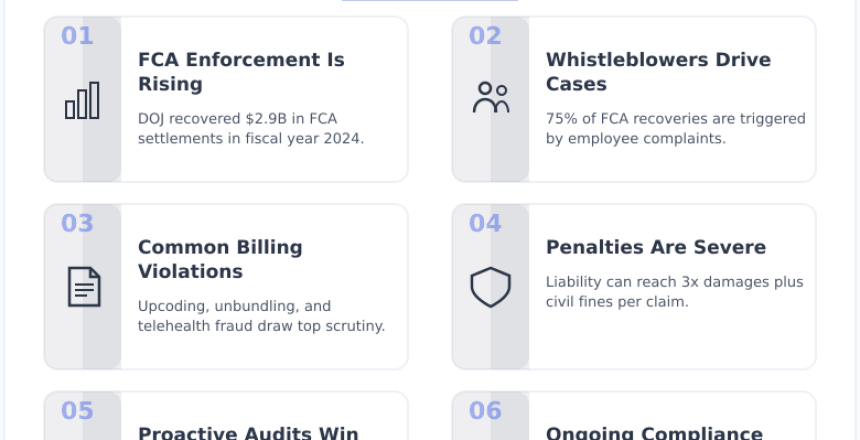
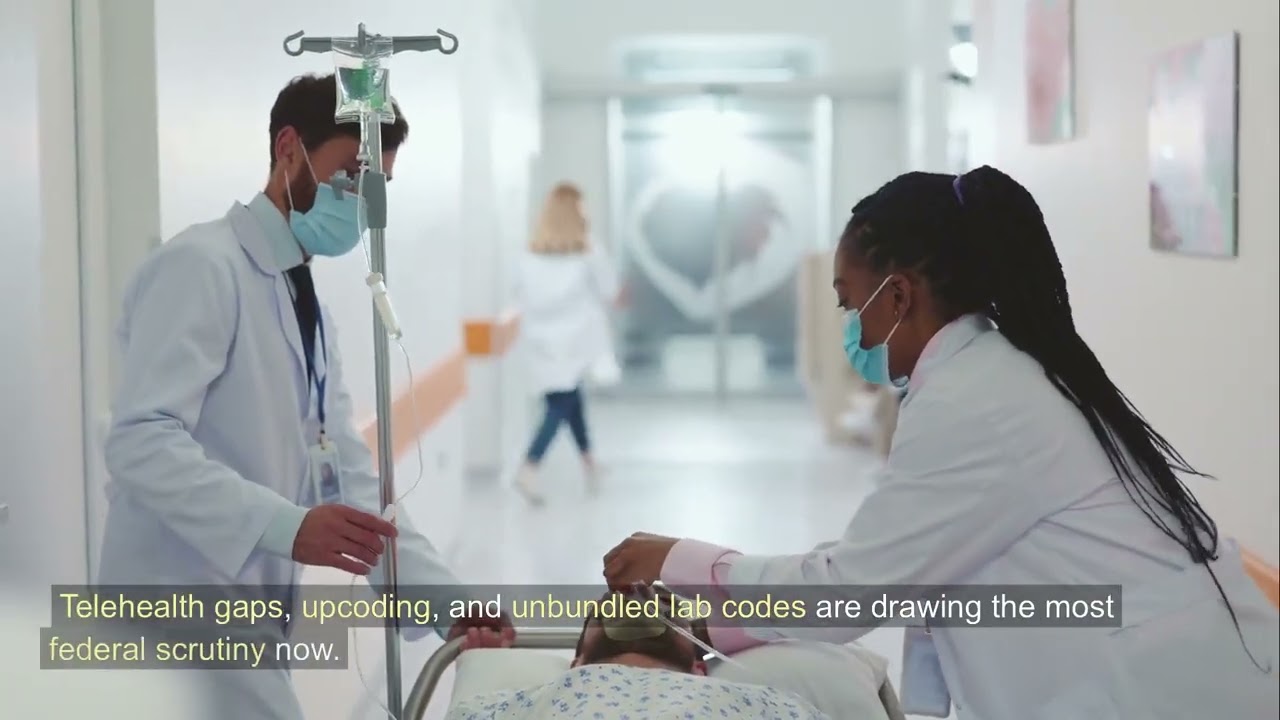
The Department of Justice recovered over $2.9 billion in False Claims Act settlements and judgments in fiscal year 2024, with healthcare accounting for the largest share. That trend is not slowing down. As of early 2026, federal prosecutors and the HHS Office of Inspector General have expanded focus on upcoding, unbundling of services, and improper use of telehealth billing codes – areas where Atlanta healthcare providers have seen heightened scrutiny.
According to DOJ data, qui tam (whistleblower-initiated) lawsuits accounted for roughly 75% of False Claims Act recoveries in recent years. That means the most common enforcement trigger is not a federal audit – it’s a current or former employee filing a complaint. Healthcare organizations in Georgia that assume they’re flying under the radar may be operating without knowing a lawsuit has already been filed under seal.
The most common mistake organizations make is treating billing compliance as a one-time training exercise rather than an ongoing process. A single miscoded procedure repeated across hundreds of claims can create liability that compounds far beyond the original billing error. Learn more about False Claims Act enforcement priorities from the U.S. Department of Justice.
Want to explore how this applies to your organization? Contact us for a direct conversation about your options – no pressure, just straight answers.
Proactive Internal Review vs. Responding After a Complaint: Which Approach Works?
Where proactive internal review succeeds: It identifies billing irregularities before federal investigators do. It creates a documented compliance record that demonstrates good faith. It allows organizations to correct overpayments voluntarily, which federal guidelines treat far more favorably than post-investigation settlements.
Where proactive internal review falls short: Without legal oversight, internal audits can inadvertently create documentation that becomes discoverable in litigation. Teams without legal guidance may not know which billing patterns regulators are currently targeting.
Where responding after a complaint succeeds: Resources are deployed only when a specific threat is identified, which can feel more efficient in the short term.
Where responding after a complaint fails: By the time an organization learns of a complaint, the government may have already been investigating for months. Settlement leverage diminishes significantly once formal proceedings begin. Penalties under the False Claims Act can reach three times the original damages plus civil fines per claim.
The verdict: Proactive review, conducted with legal guidance, produces better outcomes in nearly every scenario. The cost of an internal audit is a fraction of what False Claims Act litigation costs if it reaches discovery or trial.
| Approach | Estimated Cost | Risk Level | Best For |
|---|---|---|---|
| Proactive Internal Audit (with counsel) | $5,000 – $50,000+ depending on size | Low | Organizations billing Medicare/Medicaid regularly |
| Voluntary Disclosure to OIG | Legal fees + repayment amount | Moderate | Organizations that self-identify overpayments |
| Responding Post-Complaint | $100,000 – $1M+ in legal defense | High | No proactive option exists at this stage |
See how legal guidance fits into your billing review process – explore our services to understand the options available to your organization.
Billing Patterns That Draw Federal Scrutiny in 2026 and 2026
Federal enforcement priorities shift year to year. Current best practices flag these specific patterns as high-risk for Georgia healthcare organizations in 2026:
- Telehealth claims submitted without proper documentation of patient location or provider licensure
- Evaluation and management upcoding, particularly for new patient visits
- Unbundling of laboratory or procedural codes that should be billed as a single service
- Claims for services rendered by unsupervised non-physician practitioners in non-compliant settings
- Duplicate billing across different payer types for the same service date
According to the HHS OIG Work Plan, telehealth and home health billing remain top audit priorities entering 2026. Atlanta healthcare organizations operating in these areas face the highest near-term exposure.
Your False Claims Act Compliance Action Plan
- Step 1 – Conduct a Baseline Billing Audit: Pull claims data from the past 36 months and compare coding patterns against CMS benchmarks for your specialty. Anomalies above or below regional averages warrant closer review.
- Step 2 – Review Telehealth Documentation Practices: Ensure every telehealth claim includes compliant documentation of patient location, consent, and provider credentials as required under current Georgia and federal guidelines (2026).
- Step 3 – Assess Your Qui Tam Risk: Talk to legal counsel about your organization’s internal complaint culture. High employee turnover in billing departments increases whistleblower risk significantly.
- Step 4 – Implement a Voluntary Disclosure Protocol: If the audit surfaces overpayments, work with counsel to determine whether voluntary disclosure to the OIG is appropriate. Acting first carries real advantages under the OIG’s Self-Disclosure Protocol.
- Step 5 – Update Compliance Training: Annual training is not enough in a high-enforcement environment. Quarterly updates tied to OIG priority areas keep billing staff aligned with current standards.
What Georgia Healthcare Organizations Need to Gather Before a Consultation
- ☐ Three years of claims data by CPT code and payer type
- ☐ Current billing policies and procedure manuals
- ☐ Documentation of any prior audits or OIG correspondence
- ☐ List of employed and contracted billing personnel
- ☐ Any internal compliance complaints or HR investigations related to billing
- ☐ Copies of any payer audits, recoupment demands, or RAC (Recovery Audit Contractor) notices received in the past 24 months
Key Takeaways for Atlanta Healthcare Organizations in 2026
- Enforcement is accelerating – DOJ False Claims Act recoveries remain at historic highs heading into 2026
- Whistleblowers are the primary trigger – most cases begin internally, not with a federal audit
- Telehealth billing carries elevated risk – documentation gaps are the most common compliance failure in 2026
- Voluntary disclosure beats reactive defense – organizations that self-report overpayments consistently achieve better outcomes
- Legal guidance changes the audit outcome – unguided internal reviews can create discoverable records that hurt more than help
Frequently Asked Questions
What is the False Claims Act and how does it apply to healthcare companies?
The False Claims Act is a federal statute that imposes civil penalties on organizations that submit fraudulent claims for government payment, including Medicare and Medicaid billing. Healthcare companies that knowingly overbill, upcode, or bill for services not rendered face penalties of up to three times the damages plus per-claim fines under current 2026 law.
How do False Claims Act investigations typically start?
Most False Claims Act cases begin with a qui tam complaint filed by a whistleblower, often a current or former employee with direct knowledge of billing practices. The complaint is filed under seal, meaning the organization may not know it exists while federal investigators gather evidence.
What are the penalties for False Claims Act violations in Georgia?
Federal False Claims Act penalties include civil fines per false claim plus treble (triple) damages on the amount the government paid. Georgia also has its own State False Medicaid Claims Act, which mirrors federal standards and adds state-level exposure for Medicaid billing violations.
How long does a False Claims Act investigation take?
Federal False Claims Act investigations routinely take two to four years from initial filing to resolution, and organizations often don’t learn they are under investigation until well into that timeline. Proactive compliance efforts are more effective the earlier they begin.
What is the OIG Self-Disclosure Protocol and when should we use it?
The OIG Self-Disclosure Protocol allows healthcare organizations to voluntarily report potential fraud violations in exchange for more favorable settlement terms, typically a reduced multiplier on damages. It’s best used when an internal audit confirms overpayments before any government contact has occurred.
Do small Atlanta healthcare practices face False Claims Act risk too?
Yes – False Claims Act liability applies to any entity that bills federal healthcare programs, regardless of size. Smaller practices can face proportionally severe penalties because even a modest number of miscoded claims, repeated consistently, can produce significant aggregate liability.
What This Means for Your Organization Right Now
The window between now and 2026 is the right time to get ahead of this. Federal enforcement priorities are public, the OIG Work Plan is updated regularly, and organizations that act proactively have consistently better outcomes than those who wait for a complaint or an audit notice to arrive.
At Hasson Law Group, LLP, we work with healthcare organizations throughout Atlanta, Georgia on matters where billing practices intersect with federal compliance risk. If your organization has not reviewed its claims data in the past 12 months, that review is overdue.
Ready to take the next step? Contact us today for straight answers and real guidance on what a billing review should look like for your organization – before a complaint makes that conversation more complicated.