
False Claims Act Enforcement in 2026: Why Atlanta Healthcare Companies Should Be Reviewing Their Billing Practices Right Now
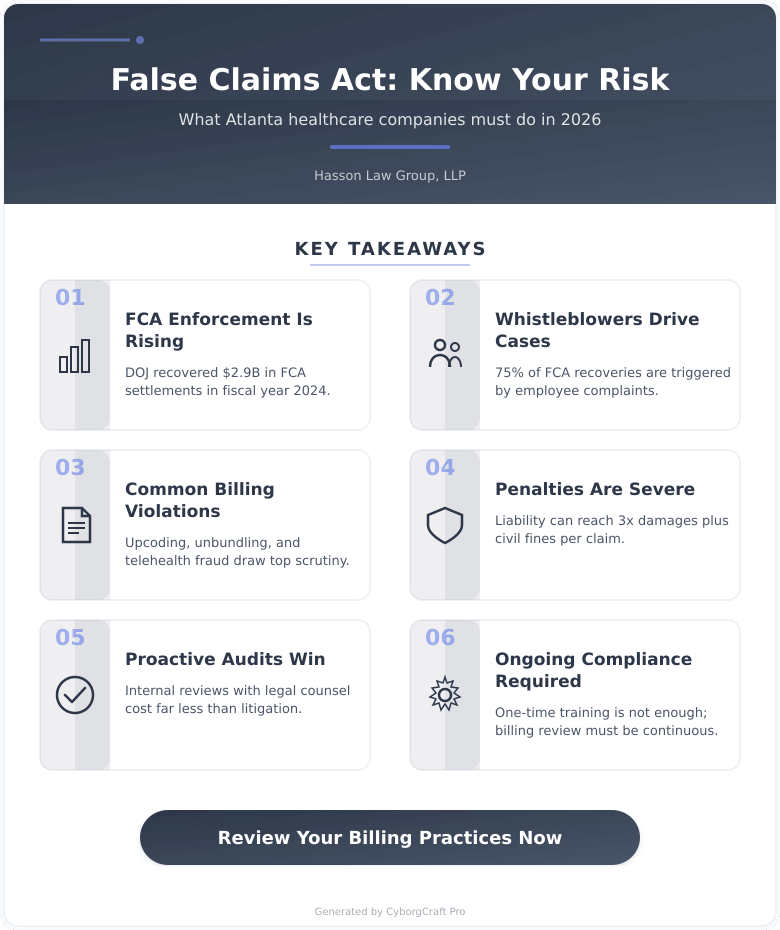
False Claims Act enforcement is intensifying heading into 2026, and Atlanta-area healthcare organizations that bill Medicare or Medicaid face real exposure if billing compliance has not been a recent priority. Federal DOJ recoveries exceeded $2.9 billion in fiscal year 2024, with healthcare accounting for the largest share. Most cases begin not with a federal audit, but with a whistleblower - often a current or former employee - filing a qui tam complaint that stays sealed while investigators build a case. High-risk billing patterns in 2026 include telehealth documentation gaps, upcoding of evaluation and management services, and unbundling of laboratory codes. The post outlines why proactive internal audits conducted with legal oversight consistently produce better outcomes than reactive defense after a complaint surfaces. Georgia organizations also face exposure under the state's own False Medicaid Claims Act, which parallels federal standards. A five-step compliance action plan covers baseline auditing, telehealth documentation review, whistleblower risk assessment, voluntary disclosure evaluation, and updated staff training. A document checklist, comparison of compliance approaches with cost ranges, and a detailed FAQ section address common questions about penalties, investigation timelines, and the OIG Self-Disclosure Protocol. The core message is clear: organizations that get ahead of billing irregularities now have far more control over the outcome than those who wait.