

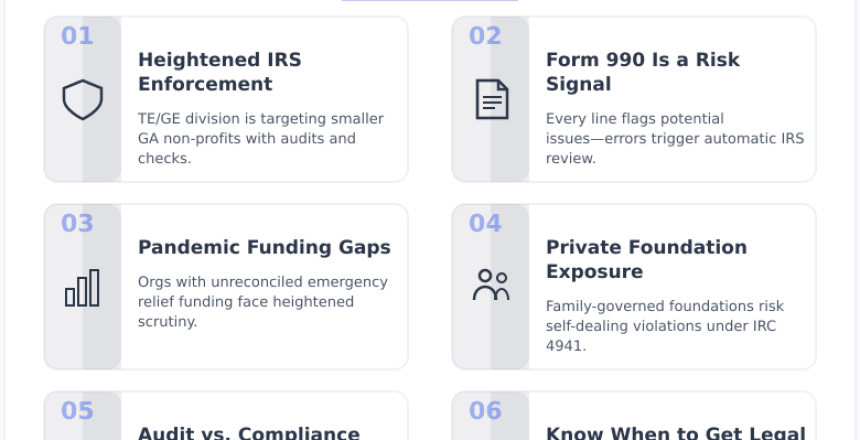
IRS scrutiny of non-profits and foundations is the increased federal examination of tax-exempt organizations to verify compliance with Internal Revenue Code requirements. For Georgia-based non-profits, this scrutiny is accelerating heading into 2026 and carries real consequences for organizations that aren’t prepared.

This guide focuses specifically on Georgia non-profits and private foundations facing heightened IRS oversight in 2026 and 2026.
Non-Profit IRS Compliance Definition: IRS compliance for tax-exempt organizations means satisfying annual reporting, operational, and governance requirements under IRC Section 501(c)(3) or related provisions to maintain federal tax-exempt status.
Most Georgia non-profit leaders assume their 501(c)(3) status is essentially permanent once granted. That assumption is getting a lot of organizations into trouble right now. The IRS has quietly shifted enforcement priorities, and the pattern we’re seeing points to a significant uptick in correspondence audits, compliance checks, and full examinations targeting smaller and mid-size charitable organizations across Georgia.
What Is Driving IRS Scrutiny of Non-Profits in 2026 and 2026
The IRS Tax Exempt and Government Entities (TE/GE) division has maintained active compliance initiatives heading into 2026 and 2026. The agency is specifically flagging organizations that received inflated pandemic-era grants, reported inconsistent program service revenue, or failed to file Form 990 on time.
IRS enforcement activity reflects ongoing concern that a number of non-profits that received emergency relief funding have not filed complete reconciliation documentation. That gap is now drawing attention. Recent data shows that private foundations in Georgia face additional exposure under the self-dealing rules of IRC Section 4941, particularly those with family governance structures.
The most common mistake we see is non-profits treating their Form 990 as a routine administrative task rather than a compliance document that directly signals risk to IRS reviewers. Every line of that form is a data point. Errors in executive compensation reporting, unrelated business income (UBI) disclosures, or grant-making records can flag an automatic review. The IRS Tax Exempt Organization Search makes every filed Form 990 publicly available, meaning your compliance record is visible to reviewers and the public alike.
Thinking about this for your situation? Let’s talk. Contact us and we’ll walk you through your options – no pressure.
IRS Non-Profit Audit vs. Compliance Check: Understanding the Difference
IRS Audit: A formal examination of an organization’s financial records, governance practices, and operational activities to determine whether tax-exempt status is being properly maintained.
Compliance Check: A less formal IRS inquiry using publicly available Form 990 data to identify potential discrepancies, often the first step before a full audit is opened.
| Review Type | Trigger | Timeline | Potential Outcome |
|---|---|---|---|
| Compliance Check | Form 990 inconsistencies | 30-90 days | Letter inquiry, no action, or escalation |
| Correspondence Audit | Specific line-item questions | 60-180 days | Penalty, repayment, or closure |
| Field Examination | Significant discrepancies or complaints | 6-18 months | Revocation, excise taxes, or clearance |
| Private Foundation Audit | Self-dealing, excess distributions | 6-24 months | Excise taxes under IRC 4940-4945 |
Self-Managed Compliance vs. Professional Legal Guidance: Which Approach Works
Where self-managed compliance succeeds: Works for very small organizations with simple structures, minimal revenue, no employees, and straightforward grant-making activity. Low cost and manageable with good bookkeeping software.
Where self-managed compliance fails: Breaks down quickly when UBI is present, executive compensation exceeds IRS benchmarks, related-party transactions exist, or the organization operates multiple programs. Errors compound year over year.
Where professional legal guidance succeeds: Provides documented compliance frameworks, response strategies when IRS contact arrives, and proactive identification of exposure before it becomes a problem. Especially valuable for foundations with self-dealing risk.
Where professional legal guidance fails: Adds cost that very small all-volunteer organizations may struggle to absorb if the legal scope isn’t clearly defined upfront.
The verdict: Any Georgia non-profit with annual revenue above $100,000, paid staff, restricted grants, or a private foundation structure should not be managing IRS compliance risk without professional legal involvement heading into 2026.
Georgia-Specific Compliance Factors Non-Profits Often Miss
Georgia non-profits face a dual compliance burden. Beyond the IRS, the Georgia Secretary of State requires annual registration renewal for charitable organizations soliciting donations in the state. Failure to renew can result in serious consequences that create a separate cascade of problems with federal tax-exempt status.
- Georgia charitable solicitation registration renews annually with the Secretary of State’s office
- Organizations raising over $25,000 in Georgia must file audited or reviewed financial statements
- Georgia’s Fair Business Practices Act applies to fundraising activities
- Private foundations in Georgia must track program-related investments separately from general assets
- Unrelated business income over $1,000 requires filing IRS Form 990-T, which Georgia also taxes
Compare that to neighboring states: Florida and Tennessee have their own distinct approaches to charitable registration and state taxation of non-profit activity. South Carolina has a streamlined charitable registration process. Georgia’s requirements sit in the middle – not the most burdensome, but complex enough that gaps appear regularly. The FTC’s guidance on charitable organizations provides additional context on federal expectations for donor-facing compliance that apply regardless of state.
Your Non-Profit IRS Compliance Action Plan
- Step 1 – Audit Your Last Three Form 990s: Pull the last three years of filed returns and compare executive compensation figures, program service revenue, and grant disbursements for internal consistency. Flag any year-over-year swings that lack documentation.
- Step 2 – Review Unrelated Business Income: Identify every revenue stream and determine whether it qualifies as UBI. Common overlooked sources include parking facilities, advertising income, and certain rental arrangements.
- Step 3 – Verify Georgia Secretary of State Registration: Confirm your charitable solicitation registration is current for 2026. Lapses create immediate exposure.
- Step 4 – Document Governance Policies: Ensure your conflict-of-interest policy, whistleblower policy, and document retention policy are written, adopted by the board, and reflected in Form 990 disclosures.
- Step 5 – Prepare an IRS Response Protocol: If you receive IRS correspondence, you have a defined window to respond. Have legal counsel identified before that letter arrives, not after.
IRS Non-Profit Compliance Preparation Checklist
- ☐ Current Form 990 filed on time (or extension filed)
- ☐ Executive compensation supported by comparability data
- ☐ All restricted grant expenditures documented by grant terms
- ☐ Board meeting minutes retained for at least 7 years
- ☐ Georgia charitable solicitation registration current
- ☐ UBI analyzed and Form 990-T filed if applicable
- ☐ Conflict-of-interest disclosures signed annually by all board members
- ☐ Private foundation excise tax calculations reviewed (if applicable)
Key Takeaways for Georgia Non-Profits in 2026
- IRS enforcement is increasing – TE/GE compliance initiatives expanded in 2026 with a direct focus on post-pandemic financial discrepancies
- Form 990 is your risk profile – every error signals potential audit triggers to IRS reviewers
- Georgia has dual compliance requirements – both federal IRS rules and state charitable registration must stay current
- Private foundations carry additional risk – self-dealing and distribution rules create excise tax exposure that compounds quickly
- Early preparation matters – organizations that address gaps before IRS contact have far better outcomes than those responding reactively
Frequently Asked Questions
What triggers an IRS audit of a Georgia non-profit?
Common triggers include late or inconsistent Form 990 filings, executive compensation that exceeds IRS comparability benchmarks, unreported unrelated business income, and third-party complaints. Organizations that received significant pandemic-era grants and have not filed complete documentation are also drawing IRS attention in 2026 and 2026.
Can a Georgia non-profit lose its 501(c)(3) status?
Yes – the IRS can revoke 501(c)(3) status for failure to file Form 990 for three consecutive years, substantial non-exempt activity, or private benefit violations. Revocation triggers back taxes and requires a formal reinstatement application, which can take 6-12 months to process.
How much does non-profit legal compliance assistance cost?
Legal fees for non-profit compliance work generally range from $1,500 to $10,000 annually depending on organizational complexity, with IRS audit representation costing significantly more. These are general industry figures; specific fees vary by firm and scope of work.
What is the difference between a public charity and a private foundation in Georgia?
A public charity receives support from a broad base of donors and qualifies under IRC Section 509(a), while a private foundation typically receives funding from a single source and is subject to stricter IRS rules including excise taxes on investment income and mandatory annual distributions. Private foundations in Georgia carry substantially more compliance complexity.
How long does an IRS non-profit examination take?
A correspondence audit typically resolves in 60-180 days, while a field examination of a non-profit or foundation can take 6-18 months. Response time and documentation quality significantly affect how quickly matters close.
Do Georgia non-profits owe state taxes on unrelated business income?
Yes – Georgia taxes unrelated business income earned by federally tax-exempt organizations at the standard corporate income tax rate. This mirrors the federal UBI tax under IRC Section 511 and requires both a federal Form 990-T and a Georgia income tax return.
What should a Georgia non-profit do when it receives an IRS letter?
Do not ignore the letter and do not respond without reviewing it carefully – IRS correspondence has specific response deadlines that, if missed, can result in automatic adverse determinations. Contact legal counsel as soon as possible after receiving any IRS inquiry related to your organization’s tax-exempt status.
What Georgia Non-Profits Should Do Right Now
The organizations that fare best when IRS scrutiny arrives are the ones that didn’t wait for it. A proactive compliance review in 2026 is far less disruptive than responding to a formal examination in 2026.
At Hasson Law Group, LLP, we work with organizations across Atlanta and throughout Georgia on complex legal matters. If your non-profit or foundation has questions about IRS exposure, compliance gaps, or what a 2026 audit response would look like, we’re here to help you think through it clearly.
Ready to take the next step? Contact us today for straight answers and real guidance. The sooner you identify gaps, the more options you have.