

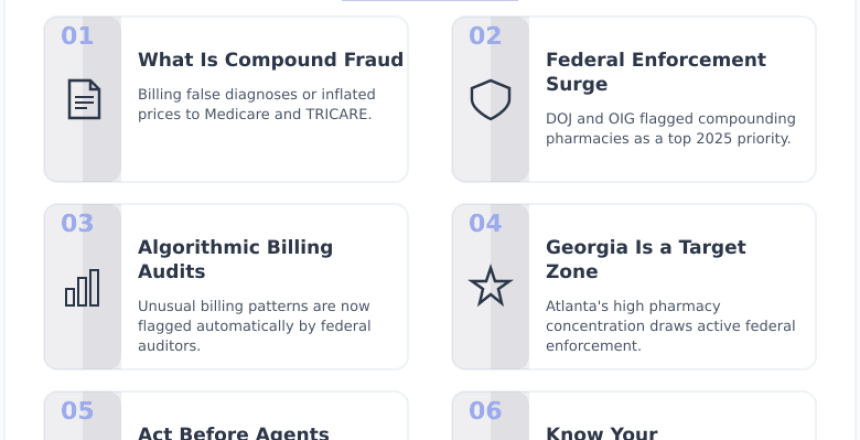
Compound pharmacy fraud investigations are federal and state-level inquiries into allegations that compounding pharmacies submitted false or inflated claims to government healthcare programs like Medicare and TRICARE. These investigations have intensified across the country in 2026, and Georgia pharmacies are squarely in the crosshairs.

This guide focuses specifically on compound pharmacy fraud investigations targeting Atlanta-area pharmacy owners and operators who may be facing scrutiny, unannounced inspections, or federal contact in 2026.
Compound Pharmacy Fraud Definition: Compound pharmacy fraud occurs when a pharmacy prepares customized drug formulations and then bills government payers for those drugs using false diagnoses, improper prescriptions, or inflated pricing schemes designed to exploit reimbursement loopholes.
The most common mistake we see is pharmacy owners assuming a DEA or OIG inquiry is routine until it is far too late to manage the situation effectively. If federal agents have already contacted you, time matters more than most people realize.
Why Compound Pharmacy Fraud Investigations Are Climbing in 2026
The Department of Justice and the Department of Health and Human Services Office of Inspector General (OIG) flagged compounding pharmacies as a top enforcement priority heading into 2026. Recent data shows that compound drug billing to federal programs grew by hundreds of millions of dollars in a relatively short window, triggering algorithmic audits that now flag unusual billing patterns automatically.
According to HHS Office of Inspector General reporting, some compounding pharmacies billed Medicare for compounds at rates 500% above standard drug costs, with little clinical justification. That kind of disparity draws attention fast.
Georgia sits in a particularly active enforcement zone. Atlanta is a major healthcare hub with a high concentration of specialty pharmacies, and federal enforcement activity in the region continues to reflect national priorities around healthcare fraud. If your pharmacy saw significant compound billing growth over the past few years, that data is already visible to federal auditors.
Want to explore this further before an agent shows up? Contact us for a confidential conversation about where your pharmacy stands.
Handling an Investigation vs. Ignoring Early Warning Signs: Which Approach Works?
Where proactive legal engagement succeeds: Early intervention allows counsel to assess billing records before the government does, identify correctable issues, and establish a defensible position. Pharmacies that engage legal counsel before or immediately after first contact tend to have more options and better outcomes.
Where proactive legal engagement fails: It requires upfront investment and honest internal review, which can be uncomfortable. Some owners resist this because they believe their billing was clean.
Where waiting and monitoring succeeds: If an inquiry is genuinely a routine audit with no underlying billing issues, inaction causes no harm. It can also avoid unnecessary legal fees in low-risk situations.
Where waiting and monitoring fails: Federal investigations move quickly once a subpoena or search warrant is issued. By that stage, the government has already built a substantial evidentiary record. Anything said to agents without counsel present can become part of that record.
The verdict: If you have received any federal communication – including Civil Investigative Demands (CIDs), subpoenas, or even informal agent inquiries – treat it as serious and get legal guidance immediately. The cost of early preparation is almost always lower than the cost of late-stage damage control.
| Investigation Stage | Typical Timeline | Risk Level | Best Action |
|---|---|---|---|
| Routine audit inquiry | 30-90 days | Low to moderate | Review billing records, consult attorney |
| Civil Investigative Demand | Active, 60-120 days | High | Retain counsel immediately |
| Search warrant / raid | Imminent prosecution stage | Critical | Do not answer questions, call attorney |
| Indictment or False Claims Act suit | Months to years of litigation | Severe | Full criminal defense strategy required |
Your Compound Pharmacy Investigation Action Plan
- Step 1 – Audit Your Own Billing Records: Pull compound billing data for the past three years. Look for patterns that could appear unusual – high-volume prescribers, unusually priced formulations, or diagnosis codes that don’t align with the compounds dispensed.
- Step 2 – Secure All Documentation: Do not delete, alter, or destroy any records. Under federal law, destroying documents after learning of a potential investigation is obstruction. Preserve everything.
- Step 3 – Identify Who Has Contacted You: Note every point of contact from any federal or state agency, including informal phone calls. Dates, names, and what was said all matter.
- Step 4 – Instruct Staff on Their Rights: Employees have the right to speak with an attorney before talking to federal agents. Make sure your team knows this clearly before any agent visit occurs.
- Step 5 – Retain Legal Counsel Before Responding: Any response to a federal inquiry – written or verbal – should go through counsel. Uncoordinated responses can waive defenses or create inconsistencies the government will exploit.
Thinking about this for your situation? Let’s talk. We’ll walk you through your options – no pressure. Reach out to the team at Hasson Law Group, LLP for a straightforward conversation about what you’re facing.
What Georgia Pharmacy Owners Should Have Ready
Documents to gather before any agent contact:
- ☐ Compound billing records for the past 36 months
- ☐ Prescriber relationships and referral documentation
- ☐ Formulary pricing records and cost justifications
- ☐ Patient medical necessity documentation
- ☐ DEA registration and inspection history
- ☐ Any prior audit correspondence from Medicare or Medicaid
- ☐ Employment records for pharmacists and pharmacy technicians
- ☐ Vendor contracts related to compounding ingredients
False Claims Act (FCA): A federal law that imposes civil liability on anyone who submits false claims for payment to the government. Compound pharmacy cases frequently involve FCA violations, which carry penalties of up to three times the false amount claimed plus per-claim fines. The Department of Justice’s False Claims Act resources outline how the government pursues these civil fraud cases.
Civil Investigative Demand (CID): A formal government tool requiring a business to produce documents, answer written questions, or give oral testimony as part of a civil fraud investigation – typically before any lawsuit is filed.
Key Takeaways for Atlanta-Area Pharmacy Owners in 2026
- Federal enforcement is accelerating – compound pharmacy billing is one of the OIG’s stated 2026 priorities
- Early legal engagement changes outcomes – the window for voluntary disclosure and cooperation is narrow once a formal investigation starts
- Georgia is an active enforcement zone – Atlanta’s healthcare density makes it a recurring target for federal healthcare fraud task forces
- Staff silence protects everyone – employees should know their right to counsel before speaking with agents
- Documentation destruction is a separate crime – preserve all records regardless of how an inquiry appears
Frequently Asked Questions
What triggers a compound pharmacy fraud investigation in Georgia?
Most compound pharmacy fraud investigations begin when billing data shows statistical outliers compared to peer pharmacies. Common triggers include unusually high compound billing to TRICARE or Medicare, prescriber referral patterns that look like kickback arrangements, and patient complaints filed with the OIG hotline.
Can a compound pharmacy be investigated even if billing was technically submitted correctly?
Yes – federal investigators look beyond technical submission accuracy to examine whether the underlying prescriptions had legitimate medical necessity. A claim can be correctly formatted and still be considered fraudulent if the drug was not medically necessary or if the prescriber had a financial relationship with the pharmacy.
What is the statute of limitations for compound pharmacy fraud claims in federal court?
Under the False Claims Act, the government generally has six years from the date of the violation to bring a civil case, and in some circumstances up to ten years. Criminal healthcare fraud charges carry their own separate timelines, making old billing records still relevant to current investigations.
Do I have to let federal agents into my pharmacy without a warrant?
Pharmacies are subject to warrantless DEA inspections under federal law, but that authority has limits. For criminal search purposes, agents generally need a warrant. You should not physically obstruct agents, but you also should not consent to searches beyond what is legally required without counsel present.
How long does a compound pharmacy fraud investigation typically take?
Federal healthcare fraud investigations routinely run one to three years from initial inquiry to resolution. The timeline depends on the complexity of billing records, the number of prescribers involved, and whether the pharmacy becomes a cooperating witness against other targets.
What penalties do compound pharmacy fraud convictions carry in Georgia federal court?
Federal healthcare fraud convictions can result in prison sentences, substantial fines, exclusion from Medicare and Medicaid programs, and permanent loss of pharmacy licensure. Civil FCA penalties alone can reach millions of dollars when multiplied across individual false claims.
What This Means for You Right Now
Compound pharmacy fraud enforcement is not slowing down. The federal government has made it a defined priority for 2026 and is signaling continued pressure into 2026. If you operate a compounding pharmacy in the Atlanta area – or anywhere in Georgia – now is the time to assess your exposure, not after an agent is standing at your counter.
Hasson Law Group, LLP, based in Atlanta, GA, works with business owners and healthcare professionals navigating complex federal inquiries. The earlier you get clarity on your situation, the more options you have.
Ready to take the next step? Contact us today for straight answers and real guidance on what a federal healthcare fraud inquiry means for your pharmacy and your future. Don’t wait for the second knock.
This content is for informational purposes only and does not constitute legal advice. For advice specific to your situation, consult a licensed attorney.