

Atlanta construction litigation is the legal process by which contractors, subcontractors, and suppliers pursue unpaid receivables, enforce mechanic’s liens, and resolve broken contracts through Georgia’s court system. For construction companies operating in 2026 and heading into 2026, these tools can mean the difference between absorbing a six-figure loss and actually getting paid.

This guide focuses specifically on Georgia construction companies dealing with unpaid invoices, disputed contracts, and lien enforcement in the Atlanta metro area.
Atlanta Construction Litigation Definition: A legal dispute resolution process used by Georgia contractors, subcontractors, suppliers, and owners to recover money owed under construction contracts, enforce mechanic’s liens, or seek damages for breach of contract through Fulton County courts and surrounding jurisdictions.
The most common mistake construction companies make is waiting too long. Georgia’s mechanic’s lien laws have strict deadlines, and missing them by even a few days can eliminate your ability to recover. The pattern shows up again and again: a contractor finishes the job, the owner drags their feet, and by the time the contractor calls an attorney, the lien window has closed.
What Atlanta Construction Companies Are Actually Owed in 2026
Construction disputes in Atlanta typically fall into a few clear categories. Unpaid progress payments and final draw disputes are the most common. But broken deals, meaning contracts that get cancelled mid-project or owners who simply walk away, are becoming more frequent as 2026’s economic pressures push project costs higher across Fulton, DeKalb, Gwinnett, and Cobb counties.
Unpaid receivables represent a significant financial burden for construction companies across the industry. According to Bureau of Labor Statistics construction industry data, the construction sector consistently faces some of the highest rates of payment disputes and business failures tied to cash flow problems. For Atlanta contractors and subcontractors, uncollected work can add up to substantial losses that affect cash flow and long-term business stability.
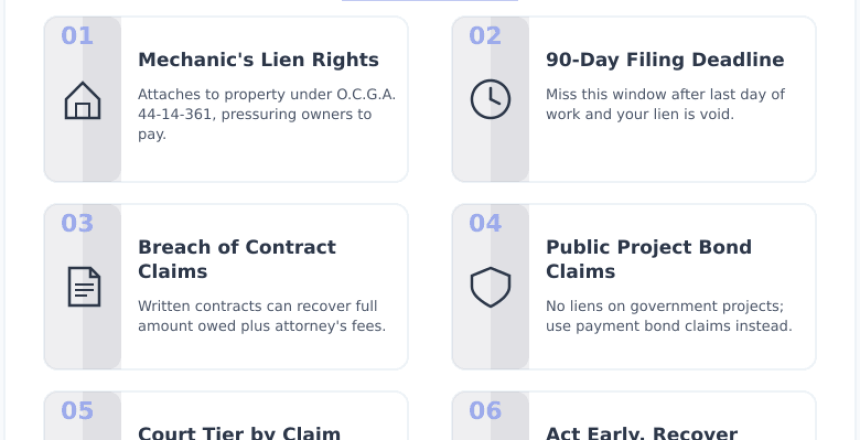
Recent shifts in Georgia courts have also made construction litigation more accessible for smaller subcontractors. Claims under $15,000 can move through Magistrate Court without formal litigation. Claims above that threshold go to State or Superior Court, where the full mechanic’s lien enforcement process applies.
Thinking about this for your situation? Let’s talk. Contact us for straight answers on your specific claim – no pressure.
Georgia Mechanic’s Lien vs. Direct Contract Claim: Which Path Works?
Where mechanic’s liens succeed: They attach directly to the property, creating real pressure on owners and lenders. They work even when the owner claims they paid the GC. Subcontractors with no direct contract with the owner still have standing. Georgia law (O.C.G.A. 44-14-361) gives lien rights to contractors, subcontractors, laborers, and material suppliers.
Where mechanic’s liens fail: Miss the 90-day deadline to file after the last day of work and the lien is void. Liens on public property (government projects) are not available – you must use a payment bond claim instead. Procedural errors in the lien itself can render it unenforceable.
Where direct contract claims succeed: If you have a written contract with clear payment terms, a breach of contract claim can pursue the full amount owed plus attorney’s fees under O.C.G.A. 13-6-11 in appropriate circumstances. These claims work on public projects where liens are unavailable.
Where direct contract claims fail: Without a written contract, proving the exact amount owed becomes harder. Disputes over change orders, scope, or quality can complicate recovery. Litigation timelines can stretch 12-24 months in Fulton County Superior Court.
The verdict: For private projects, file the lien first and negotiate from a position of strength. For public projects, trigger the payment bond claim immediately – the deadlines are just as strict. Most successful recoveries in 2026 and 2026 combine both lien enforcement and contract breach claims simultaneously.
| Legal Tool | Typical Cost (2026) | Timeline | Best For |
|---|---|---|---|
| Mechanic’s Lien Filing | $500 – $2,500 | 30-90 days to file | Private property, unpaid subs |
| Payment Bond Claim | $1,000 – $3,500 | Notice within 90 days of last furnishing, suit within 12 months | Public projects, government work |
| Contract Breach Lawsuit | $5,000 – $25,000+ | 6-18 months | Large disputed amounts, broken deals |
| Magistrate Court Claim | $100 – $500 | 60-90 days | Claims under $15,000 |
Your Atlanta Construction Dispute Action Plan
- Step 1 – Document Everything Immediately: Compile all contracts, change orders, invoices, emails, and site photos. Courts expect organized evidence and gaps hurt credibility.
- Step 2 – Calculate the Lien Deadline: Count 90 days back from your last day furnishing labor or materials. That is your hard deadline under Georgia law (2026).
- Step 3 – Send a Formal Demand Letter: A written demand triggers the dispute record and sometimes produces payment without litigation. It also documents bad faith if the owner refuses.
- Step 4 – File the Mechanic’s Lien: File in the county where the property sits (Fulton, Gwinnett, DeKalb, Cherokee, etc.). The filing fee is approximately $25-$50 per county (2026 rates).
- Step 5 – Foreclose or Negotiate: You have 365 days from the lien filing to commence foreclosure in Georgia. Use that window to negotiate a settlement or prepare to litigate.
- Step 6 – Pursue Attorney’s Fees if Applicable: Georgia law allows recovery of legal fees in certain stubborn nonpayment situations. Ask your attorney whether the facts support this claim.
Documents You Need Before Your First Consultation
- ☐ Signed prime contract or subcontract
- ☐ All executed change orders (signed and unsigned)
- ☐ Unpaid invoices with dates and amounts
- ☐ Lien waiver records you have already signed
- ☐ Email and text chains showing payment disputes
- ☐ Notice to Owner documentation (if filed)
- ☐ Project completion records or substantial completion dates
- ☐ Bond information for public projects
Common Mistakes That Kill Construction Claims in Georgia
Missing the 90-day lien deadline: Georgia does not extend this deadline for any reason. Work backward from your last day on site and file early if there is any doubt about the date.
Signing unconditional lien waivers too early: Some general contractors push subcontractors to sign broad lien waivers before checks clear. A waiver signed before payment is received can eliminate your rights entirely.
Skipping the Notice to Contractor: On projects where you have no direct contract with the owner, filing a Notice to Contractor (also called a Notice to Owner) within 30 days of first furnishing work is essential. Missing it can limit your lien rights significantly. The FTC’s guidance on understanding contracts provides useful context on how written agreements and notice provisions protect all parties in a business relationship.
Waiting for negotiation to resolve the dispute: Negotiations are fine, but do not let the lien deadline pass while talks drag on. File the lien, then negotiate.
See how a structured legal approach compares to going it alone. Visit our services page for a full overview of how Hasson Law Group, LLP approaches construction and business disputes in Atlanta, GA.
Key Takeaways for Atlanta Contractors in 2026
- Deadlines are hard stops – Georgia’s 90-day lien window does not bend for negotiations or goodwill
- Public vs. private projects require different tools – liens work on private property, payment bonds apply to government work
- Written contracts matter enormously – verbal agreements make recovery significantly harder in Atlanta-area courts
- Attorney’s fees are recoverable in some cases – Georgia law rewards aggressive pursuit of stubborn nonpayment
- File first, negotiate second – having a recorded lien gives you real leverage at the bargaining table
Frequently Asked Questions
How long does a contractor have to file a mechanic’s lien in Georgia?
Georgia contractors have 90 days from the last date of furnishing labor or materials to file a mechanic’s lien. This deadline is absolute under O.C.G.A. 44-14-361.1. Missing it by even one day eliminates your lien rights regardless of how much you are owed.
Can a subcontractor file a lien even without a direct contract with the property owner?
Yes, Georgia law gives lien rights to subcontractors, laborers, and material suppliers even without a direct contract with the owner. Filing a timely Notice to Contractor within 30 days of first furnishing work strengthens and preserves those rights significantly.
How much does construction litigation cost in Atlanta?
Atlanta construction litigation costs vary widely based on claim size and complexity, ranging from a few hundred dollars for Magistrate Court claims to $25,000 or more for contested Superior Court cases. Attorney fees are sometimes recoverable under Georgia law in nonpayment situations, which can offset litigation costs.
What happens after a mechanic’s lien is filed in Georgia?
After filing, the lien attaches to the property title and creates a cloud that prevents the owner from selling or refinancing without resolving it. You then have 365 days to file a lien foreclosure lawsuit, during which settlement negotiations typically intensify.
Do Georgia mechanic’s lien laws apply to public construction projects?
No, mechanic’s liens cannot be filed against public property in Georgia. For government and public projects, contractors and subs must instead make a claim against the payment bond, with its own strict notice deadlines.
What is the statute of limitations for a construction breach of contract claim in Georgia?
Written construction contracts in Georgia carry a six-year statute of limitations for breach of contract claims. Verbal agreements carry a four-year window. However, acting quickly still matters because evidence disappears and witnesses become harder to locate over time.
Which Atlanta-area courts handle construction disputes?
Construction disputes in the Atlanta metro are handled by Magistrate Court (claims under $15,000), State Court, and Superior Court in Fulton, DeKalb, Gwinnett, Cobb, Cherokee, and surrounding counties. The court depends on the claim amount and the type of relief requested.
What This Means for Your Business Right Now
Construction companies across Atlanta are heading into 2026 with more tools than ever to recover unpaid work. But those tools only function if you use them on time and correctly. The receivables sitting in your accounts today have a legal shelf life, and that clock is running.
Hasson Law Group, LLP serves contractors, subcontractors, and suppliers throughout Atlanta, Georgia, including clients in Fulton, DeKalb, Gwinnett, Cobb, Cherokee, Clayton, and Henry counties.
Ready to take the next step? Contact us today for straight answers and real solutions. The sooner you act, the more options you have.