

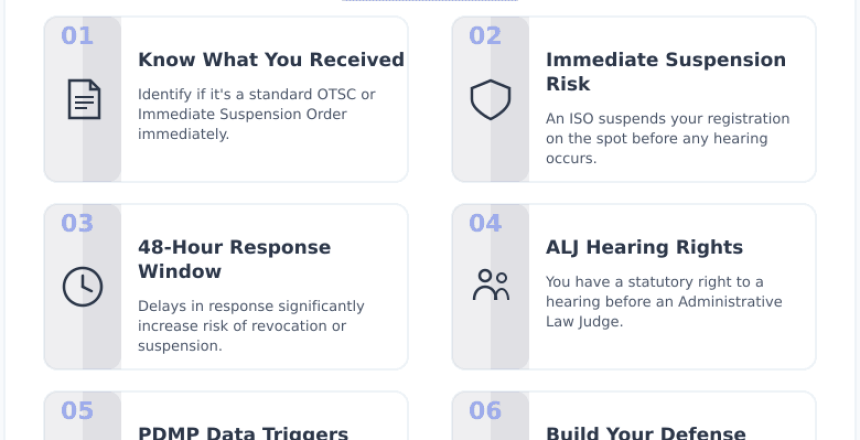
A DEA show cause order is a formal administrative action issued by the Drug Enforcement Administration that initiates proceedings to revoke or suspend a registrant’s controlled substance registration. For Atlanta-area pharmacists and prescribers, receiving one can halt your practice entirely if you don’t move fast and move smart.
This guide focuses specifically on the critical first 48 hours after receiving a DEA show cause order, with practical steps for Georgia-licensed pharmacists and prescribers facing administrative action in 2026.
DEA Show Cause Order Definition: A DEA Order to Show Cause (OTSC) is an administrative complaint formally notifying a DEA registrant that the agency intends to revoke or suspend their controlled substance registration, triggering a statutory right to a hearing before an Administrative Law Judge.
DEA show cause orders remain a serious and active enforcement tool heading into 2026. The DEA has continued to pursue administrative actions targeting retail pharmacies, independent prescribers, and pain management providers. If you’ve received one, or you’re worried about being next, understanding the process and your rights is not optional.
Why Atlanta Pharmacists and Prescribers Are Seeing More DEA Actions in 2026
The DEA’s enforcement posture has shifted considerably. Through 2026, the agency focused investigative resources on opioid prescribing patterns flagged by Prescription Drug Monitoring Programs (PDMPs). Georgia’s PDMP – managed through the Georgia Drugs and Narcotics Agency (GDNA) – feeds data directly into federal review pipelines.
Here’s what that means practically: a prescribing pattern that looked borderline two years ago may now trigger a formal investigation. Pharmacies that dispensed based on facially valid prescriptions can still face show cause proceedings if the DEA argues they should have identified red flags.
- High-volume controlled substance dispensing relative to regional averages
- Cash-pay patient patterns in Schedule II or III medications
- Prescriptions originating from out-of-state practitioners
- Distance between prescriber location and patient address
- Prior DEA warnings, letters of admonition, or compliance inspections
Show cause proceedings that are not met with a timely and adequate response carry a significant risk of resulting in suspension or revocation. That outcome is avoidable with the right response.
Thinking about this for your situation? Let’s talk. Contact us at Hasson Law Group, LLP for a direct conversation about what you’re facing – no pressure, no obligation.
Immediate vs. Suspension Orders: What You Actually Received
Where a standard Order to Show Cause succeeds: It preserves your right to continue practicing while the administrative hearing process plays out. You have time to build a defense, gather records, and appear before an ALJ.
Where a standard Order to Show Cause fails: Many registrants misread the severity, delay response, or assume the process moves slowly enough to give them time. It doesn’t.
Where an Immediate Suspension Order (ISO) succeeds: The DEA issues an ISO when it believes continued registration poses an imminent danger to public health or safety. Receipt of an ISO means your registration is suspended on the spot – not after a hearing.
Where an Immediate Suspension Order fails: An ISO can be challenged. The ALJ must hold a hearing within 45 days when an ISO is issued alongside a show cause order. That narrow window is your main opportunity.
The verdict: The distinction between a standard OTSC and an ISO changes your entire response strategy. Confirm within hours which one you received – your attorney needs to know immediately because the procedural rights and deadlines differ significantly.
| Order Type | Practice Continues? | Hearing Timeline | Best Response |
|---|---|---|---|
| Standard OTSC | Yes, until hearing | Scheduled by ALJ (typically 60-90 days) | File timely hearing request, build defense |
| ISO + OTSC | No – immediate halt | Within 45 days (statutory) | Emergency legal response within 24 hours |
| Informal DEA Letter | Yes | No ALJ proceeding yet | Voluntary compliance response, legal review |
Your DEA Show Cause Order Action Plan for the First 48 Hours
- Step 1 – Confirm Receipt and Document Everything (Hours 0-2): Note the exact date and time you received the order. Do not discard the envelope. Preserve the original mailing and any accompanying documents. This timestamp controls your response deadlines.
- Step 2 – Do Not Contact the DEA Directly (Hours 0-48): Anything you say to DEA investigators without counsel present can and will be used in the administrative proceeding. Decline to respond substantively until you have legal representation.
- Step 3 – Retain Legal Counsel With Administrative Law Experience (Hours 2-8): This is not a matter for general practice attorneys. You need counsel who understands DEA administrative proceedings, ALJ practice, and Georgia pharmacy law. The most common mistake we see is registrants waiting days before contacting an attorney.
- Step 4 – Gather Your Dispensing or Prescribing Records (Hours 8-24): Pull the patient records, dispensing logs, and PDMP reports relevant to the allegations. Your attorney will need these to assess the strength of the DEA’s case and identify defenses.
- Step 5 – File a Timely Hearing Request (Within 30 Days Statutory Deadline): Under 21 U.S.C. Section 824, you have the right to request a hearing before an ALJ. Failing to request a hearing is treated as a waiver. Your attorney should file this request – don’t let the deadline slip.
- Step 6 – Notify Your Employer or Practice Group (Hours 24-48): If you practice within a hospital system, group practice, or pharmacy chain, your employment agreement likely requires prompt notification of administrative actions. Failing to disclose can create separate legal exposure.
- Step 7 – Review Your Georgia PDMP Compliance Posture: The GDNA requires Georgia prescribers to check the PDMP before prescribing Schedule II substances. Document your compliance history now – gaps here are often cited in DEA proceedings.
See how our services at Hasson Law Group, LLP can support you through this process. We work with licensed professionals in Atlanta and throughout Georgia facing high-stakes regulatory actions.
What the DEA Must Prove – and Where Defenses Live
The DEA carries the burden of showing that a registrant’s continued registration is inconsistent with the public interest under 21 U.S.C. Section 823. That standard is not automatic just because an order was issued. Registrants can and do prevail at ALJ hearings.
Public Interest Factors the DEA Must Address:
- The registrant’s prior compliance with applicable state and federal laws
- Experience in dispensing or conducting research with controlled substances
- Conviction record under federal and state laws relating to controlled substances
- Past experience in dispensing, and the existence of state authority to dispense
- Any other conduct that may threaten the public health and safety
Firms that build their defense around documented compliance history – PDMP checks, pharmacist due diligence records, continuing education certificates – typically see stronger outcomes at the ALJ stage. The pattern we observe most: registrants who can show proactive compliance steps, even imperfect ones, fare significantly better than those who offer no affirmative record. The DEA’s Controlled Substances Act resource page outlines the statutory framework governing registration and public interest determinations that apply to these proceedings.
Georgia-Specific Compliance Requirements That Affect Your Defense
Georgia pharmacy and medical licensing operate through separate but interrelated systems. The Georgia State Board of Pharmacy and the Georgia Composite Medical Board both receive notice of DEA administrative actions, meaning a federal proceeding can trigger parallel state licensing consequences.
Under current Georgia law (2026), prescribers must register with the Georgia PDMP and are required to check it before issuing Schedule II prescriptions. Pharmacists have a corresponding duty to exercise professional judgment before dispensing – what the DEA calls a corresponding responsibility.
Georgia DEA Diversion Investigators operate out of the Atlanta Field Division, which covers the entire state. That office has increased audit activity in the Fulton, DeKalb, Gwinnett, and Cobb County corridors through 2026, targeting both independent pharmacies and outpatient prescribers.
Common Mistakes That Make DEA Proceedings Worse
Mistake 1 – Talking to Investigators Without Counsel: DEA diversion investigators are trained interviewers. Voluntary statements made before you understand the full scope of allegations routinely become the most damaging evidence in a hearing.
Mistake 2 – Missing the Hearing Request Deadline: The 30-day window to request an ALJ hearing is statutory. A late filing is treated as a default, and the DEA can revoke your registration without a hearing.
Mistake 3 – Destroying or Altering Records: Document preservation is mandatory once you receive an OTSC. Altering dispensing logs or prescription records – even to correct errors – can convert an administrative matter into a criminal obstruction issue.
Mistake 4 – Assuming State Licensure Protects You: Your Georgia pharmacy license and your DEA registration are separate. Losing one does not automatically mean losing the other, but the proceedings often run in parallel. Treat both tracks seriously from day one.
Mistake 5 – Waiting to Engage Legal Help: The first 48 hours shape everything that follows. Attorneys who enter a case in week three are working around decisions made in week one. Early engagement changes outcomes.
Key Takeaways for Atlanta Pharmacists and Prescribers in 2026
- Time is the most critical variable – the first 48 hours determine whether your defense is strong or reactive
- Distinguish your order type immediately – an ISO and a standard OTSC require completely different response speeds
- Do not speak to DEA investigators without counsel present – early statements frequently become the central evidence in ALJ proceedings
- Georgia’s PDMP compliance record matters – document your history now, before your attorney reviews it
- Parallel state licensing actions are real – coordinate your federal and Georgia state board responses from the start
Frequently Asked Questions
What triggers a DEA show cause order for a pharmacist or prescriber?
DEA show cause orders are typically triggered by prescribing or dispensing patterns flagged through PDMP data analysis, DEA diversion investigations, or complaints from patients or other practitioners. Common triggers include high-volume Schedule II dispensing, cash-pay patient concentrations, and prescriptions that exhibit characteristics the DEA associates with diversion. Not every investigation results in an OTSC, but any DEA contact warrants legal review.
How long does a DEA administrative hearing process take in Georgia?
A standard DEA show cause proceeding from the filing of the OTSC to a final DEA administrator decision typically takes 12-18 months, though immediate suspension cases move faster due to the 45-day hearing requirement. The ALJ issues a recommended decision, which the DEA administrator can accept, modify, or reject. Georgia practitioners should expect the Atlanta Field Division to remain active throughout.
Can I keep practicing after receiving a standard Order to Show Cause?
Yes – a standard OTSC does not suspend your registration while the hearing process is pending. You may continue to prescribe or dispense controlled substances unless an Immediate Suspension Order accompanies the OTSC. Confirm the exact order type with your attorney within hours of receipt.
What does a DEA administrative hearing cost in general?
DEA administrative defense costs vary widely based on case complexity, volume of records involved, and whether professional witnesses are required. General industry ranges for contested DEA proceedings run from $15,000 to $75,000 or more for complex cases. These figures reflect general market context and are not the fees of any specific firm.
Does a DEA action automatically affect my Georgia medical or pharmacy license?
A DEA show cause order does not automatically revoke your Georgia state license, but the Georgia State Board of Pharmacy and the Georgia Composite Medical Board both receive notice of federal administrative actions and may open parallel proceedings. Proactive communication with your state licensing board, through counsel, is generally advisable.
What documents should I gather immediately after receiving a show cause order?
Gather all dispensing records, prescription logs, PDMP check documentation, patient charts relevant to the cited allegations, DEA inspection reports, and any prior correspondence from DEA diversion investigators. Your attorney will use these to identify the scope of the allegations and build an affirmative compliance record for the hearing.
What This Means for Atlanta-Area Registrants Right Now
In February 2026, DEA issued five ISOs and one OTSC in one online pharmacy enforcement action. DEA administrative enforcement remains an active and consequential area for Atlanta pharmacies and medical practices across Fulton, DeKalb, Cobb, Gwinnett, and Cherokee counties. If you’ve received an OTSC or an ISO, or if you’ve had a recent DEA inspection that ended with unresolved questions, don’t wait to get clarity on where you stand.
Ready to take the next step? Contact us today at Hasson Law Group, LLP at 3379 Peachtree Road, Suite 625, Atlanta, GA 30326. Get straight answers about your situation and a clear picture of what the next steps actually look like – before the 48-hour window closes.